
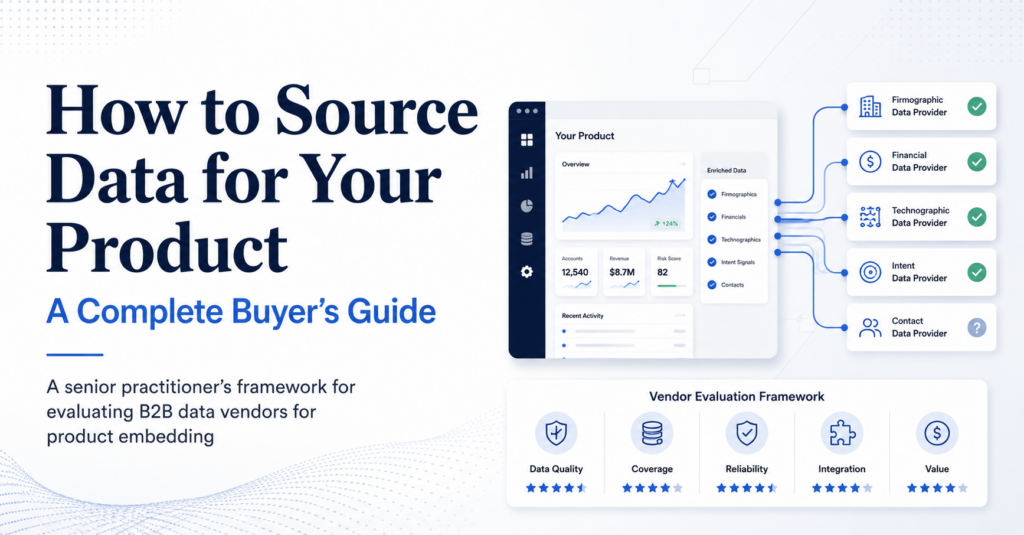
A senior practitioner's framework for evaluating data vendors when you are embedding their data into your product, not just enriching your CRM.
Sourcing data for a product is not the same job as sourcing data for GTM. The scale, terms, and delivery requirements are fundamentally different. If you assume they are the same, you will pay for that assumption for years.
If you are building a data-powered product, sourcing data is one of the highest-leverage decisions you will make. Get it right, and you have a defensible foundation your engineering team can build on for years. Get it wrong, and you inherit a set of problems that no amount of internal work can fix: coverage gaps you cannot backfill, contract terms that prevent you from monetizing your own product, credit systems that make unit economics impossible to model, and delivery architectures that force your users to wait when they need to move.
The teams that source data well share one thing in common. They treat vendor selection like an engineering discipline, not a purchasing exercise. They evaluate providers against a specific framework, run structured tests before signing, and negotiate contracts with the same care they would apply to a payment processor or a cloud provider. Everyone else improvises, then spends the next twelve months rebuilding what they should have gotten right the first time.
This guide is the framework SpringDB walks clients through when they engage us to source data for a product. It covers nine evaluation dimensions in the order they matter, and closes with the single most important decision most product teams overlook until it is too late: how you actually own and serve the data at scale.
Data for GTM lives inside your CRM. It gets consumed by sellers, marketers, and RevOps. Contract terms usually restrict use to internal purposes, credits are metered per user or per record, and the data lives behind your firewall. Data for a product is different. It flows through your product to your customers. It gets served at scale, potentially over API, and users may consume it in ways the vendor never contemplated. Every dimension below is affected by that shift.
Know What You Are Looking For
Before you evaluate a single vendor, do the work to identify the gap you are trying to fill. Not the general category of data you think you need, but the specific differential that makes your product defensible.
So you identified the type of data you are looking for. Now what? Sit with three questions before you talk to any vendor.
Product teams that skip this step end up evaluating vendors against a moving target. They start asking generic questions in demos, the vendor answers with generic strengths, and the buying process becomes a comparison of pitches rather than a comparison of fit. If you can answer these three questions crisply, the nine dimensions below become dramatically easier to work through, because you know what you are looking for before you look.
The best data sourcing decisions start with a specific gap and a specific differential. Everything else in this guide gets easier once those two are on the whiteboard.
Where Each Vendor Actually Deserves to Win
Every data vendor claims to be comprehensive. Almost none of them actually are. The first question to answer is not "which vendor is best?" but "which vendor is genuinely best at the specific job we need done?" That framing changes everything downstream, including how much you should pay and what you should demand in the contract.
Data vendors typically excel in one of six specialties. Contact data (offline), where the value lies in names, verified emails, direct dials, mobile numbers, physical addresses, and life-stage attributes like marital status. Identity graph (online), which is also contact data but of a different kind: IP addresses, mobile device IDs, hashed emails, LinkedIn and social profiles, cookie graphs, and web movement signals. Both are ways to reach or identify a person, but they get collected differently and serve different product use cases. Firmographics, where the value lies in company-level attributes like industry, employee count, revenue, and hierarchy. Technographics, where the value lies in knowing what tools a company uses and increasingly how much they spend on those tools. Intent, where the value lies in behavioral signals about which accounts are researching your category right now. And verticalized segmentation, a category that covers everything else: shipping routes, weather patterns, credit card data, healthcare attributes, education records, financial signals, and any industry-specific data that does not fit neatly into the other five categories.
A vendor that leads in one specialty rarely leads in all six. This is not a criticism. It is the natural result of how these datasets get built. A firm that spent a decade collecting technographic install signals through crawling and interviews cannot suddenly become the best identity graph provider, because those are different disciplines with different investments behind them. Similarly, an identity graph provider with strong online signals rarely also owns the offline contact data supply chain that produces verified mobile numbers and physical addresses.
The practical implication is that most serious product teams end up using two or three vendors, one leading in the specialty they care about most and others filling gaps. This is the sourcing pattern SpringDB sees most often across its Data Exchange implementations. The teams that force a single vendor to cover everything usually pay more and get less than the teams that acknowledge specialty and build around it. We cover this topic in depth on the SpringDB podcast, where guests from partner data providers walk through where their category actually delivers value.
What Global Actually Means
Coverage is where marketing meets reality. Every enterprise data vendor claims global reach. Almost none of them mean what a product team hears when they read that claim.
In practice, most global B2B datasets are strongest in the United States, meaningfully strong in Western Europe (specifically UK, Germany, France, Netherlands, Nordics), moderately covered in Australia and Canada, and thin everywhere else. If your product needs to serve customers in Latin America, Southeast Asia, the Middle East, or Africa, you cannot rely on a single provider to cover those regions well. You need to verify. Ask for regional match rates broken down by country, not a headline global number.
Regional coverage also affects governance. GDPR in Europe, CCPA and CPRA in California, the Personal Data Protection Act in India, LGPD in Brazil, and PIPL in China each impose different requirements on how data is collected, stored, and used. A vendor that operates cleanly in the US may have real gaps in Europe, or vice versa. When you embed a vendor's data in your product, you inherit their compliance posture. That inheritance is much heavier if you sell internationally.
Horizontal + Vertical, Not Either/Or
Alongside geography, industry focus is the second axis where general-purpose data vendors tend to weaken. But the framing that gets most product teams into trouble is treating this as a choice between horizontal providers and vertical providers. It is not. The right answer for almost every serious data product is to run both.
Always start with a horizontal provider as your base. Layer vertical sources on top for the segments where you need deeper attributes.
Here is why. Horizontal providers cover every industry adequately. They give you the general information every product needs regardless of vertical: mobile phone numbers, verified emails, firmographic basics, physical addresses, standard role taxonomies. Vertical providers do not generally invest in these basics. They invest in the deep, industry-specific attributes that horizontal generalists ignore. Specialty codes, license numbers, regulatory identifiers, industry role taxonomies, verticalized signals.
If you pick only a vertical provider, you lose the horizontal basics. If you pick only a horizontal provider, you lose the vertical depth. If your product serves any vertical seriously, or serves multiple verticals with different attribute needs, you need both. The SpringDB Data Exchange includes both horizontal and verticalized providers precisely because this layering is the norm, not the exception.
A pattern SpringDB sees frequently: teams start with a horizontal vendor because it seems simpler, then bolt on vertical sources six months later once they realize the horizontal data does not cover the attributes their users actually need. That approach works, but it is slower and messier than planning the horizontal + vertical layering from the beginning. Understand your vertical requirements before you sign the horizontal contract, so the two contracts fit together and the stitching is designed intentionally, not scrambled together after the fact.
How Vendors Collect Their Data and Why It Matters
Governance is the dimension teams most often skip and most often regret. A data vendor's collection methodology determines whether the data you embed in your product is legally defensible, ethically sound, and durable over time. Get this wrong and you can face downstream liability that dwarfs the cost of the contract.
Whichever model your vendor uses, you inherit that risk profile the moment you embed the data in your product. Licensed data is the safest but usually the smallest. Scraped data is often the broadest but carries the highest legal exposure and can vanish overnight if the source site changes its policies or wins a court case. User-contributed data is somewhere in between.
Ask your vendor to walk you through their collection methodology on a call, not in marketing copy. If the answer is vague, if the sales rep does not know, or if the answer changes when you follow up, you have your answer.
How to Verify Data Before You Buy
Once you have narrowed your shortlist based on specialty, geography, industry, and governance, testing is what separates the vendor claims from the reality. Every vendor will tell you their coverage is high and their accuracy is above 95%. Almost none of them will publish the regional or vertical breakdowns behind that number. Testing is how you get honest answers.
The Match Test
Evaluates how well a vendor enriches records you already have. Provide the vendor with a representative sample of your existing data (usually 5,000 to 10,000 records, ideally covering the segments you care about most) and ask for a match report broken down by field. What percentage of records returned a verified email? A mobile phone? A current job title? The answers will be meaningfully lower than the vendor's headline number.
The Coverage Test
Evaluates how much data the vendor can actually deliver against your product's requirements. This is different from a GTM coverage test, where you would hand a vendor an ICP and ask them to pull matching accounts. For a product, you are usually asking a more specific question: can this vendor supply the attributes and volume my product needs, across the segments my product covers, at the freshness my users expect?
Structure the test around your actual product requirements, not a persona. If you are adding technographic data to your product, hand the vendor a specific list of technology categories and companies your users will look up, then ask what percentage of those return complete records with the fields you care about. If you are building a geographic coverage feature, define the countries and cities that matter to your users, then ask for population-level match rates broken down by region. If you are enriching identity graph data, provide a sample of the input signal types (email, mobile ID, hashed identifier) and ask what resolution rate the vendor delivers on each.
Coverage claims collapse fast under this kind of testing. A vendor claiming 100 million records may only have 400,000 that match the exact attributes your product needs. Better to find that out before you sign than after your users start filing tickets about missing data.
How to Know If Vendor Pricing Is Fair
Pricing in the B2B data market is opaque by design. Most vendors do not publish rates, and those who do often bury the details behind minimum commitments and enterprise sales gates. The result is that most product teams pay more than they should for their first data contract, then rebuild the contract painfully at renewal once they understand the market.
| Data Type | Annual Range | Why It Ranges |
|---|---|---|
| Contact data (offline) | $100K – $500K | Verified mobile/email at scale is expensive to maintain |
| Identity graph (online) | $150K – $750K | Cross-signal resolution and freshness command a premium |
| Intent data | $75K – $300K | Volume of signals x freshness of the data |
| Signal data | $100K – $500K | Recurring value from funding, job changes, technographic shifts |
| Firmographic data | $50K – $200K | Company-level attributes; more commoditized supply |
| Specialty vertical data | $75K – $600K | Depth and exclusivity in a niche drives high variance |
The right benchmark for your specific contract is not a public list price. It is what comparable companies with similar volume and use cases are paying. This is where an implementation partner adds real value. SpringDB's engagements often include price benchmarking against contracts we have negotiated across a hundred-plus implementations. Without that reference, the vendor holds all the information asymmetry.
Two pricing patterns to watch. First, credit-based pricing. Credits often look cheap in the demo but compound quickly at scale. If your product will trigger enrichment on millions of records annually, model out your true credit consumption before signing, including the credits burned on failed lookups. Second, tiered pricing with usage cliffs. Some contracts step up sharply once you exceed a threshold. Understand the cliff before you cross it.
The Pricing Model That Actually Matters for Product Teams
The pricing conversation most vendors want to have is about credits, tiers, and per-record fees. The pricing conversation product teams should push for is different. If you are building a data product that will scale, the single most important pricing decision you can make is to get an all-you-can-eat flat file license, not a consumption-based API contract.
- Cost scales linearly (or worse) with user growth
- Popular features can blow up your data spend overnight
- Unit economics get worse as you succeed
- Vendor captures the upside of your growth
- Cost is fixed and predictable
- Growth improves your margin instead of eroding it
- You control freshness, query speed, and rendering
- You keep the upside of your own product's growth
Here is the math most product teams do not run until it is too late. A consumption-based API at, say, $0.50 per enriched record looks fine when you are running 20,000 enrichments a month. That is $10,000 monthly. Grow your product 20x, and you are running 400,000 enrichments a month. That is $200,000 monthly, $2.4M annually, and the vendor's revenue from you now looks a lot like a tax on your success. An all-you-can-eat flat file at $250,000 to $500,000 annually delivers the same data and scales with you rather than against you.
Vendors will resist all-you-can-eat pricing because it caps their upside. Push anyway. Frame it as a longer commitment (multi-year contract) and higher up-front spend in exchange for volume certainty. Most enterprise data vendors have all-you-can-eat SKUs even if they do not advertise them. Ask directly. Our RevOps Bench has negotiated these arrangements with most of the major B2B data providers, and we know which vendors flex on this and which do not.
If you are building a platform that will bring on more and more users, consumption-based pricing gets exponentially expensive. Flat file licensing at scale is how SpringDB serves data through InstaDB to product teams that have graduated past consumption models. We come back to that architecture at the end of this guide.
The Terms That Determine Whether You Actually Own What You Are Buying
This dimension is where product teams most often lose the most money, and where the standard vendor contract is most likely to be a trap. Almost every B2B data vendor's default contract prohibits redistribution. In plain terms, that means you cannot sell their data to your customers. If you did not negotiate an exception, you cannot legally embed the vendor's data in a product you sell. Many teams sign the default contract, then discover this restriction only when they are ready to launch.
There are five specific clauses that matter most for product use cases:
This is the single dimension where an experienced partner adds the most value. Our RevOps Bench has negotiated these clauses with most of the major B2B data providers, and we know where each vendor is flexible and where each vendor holds firm. Without that context, you will spend three months of legal cycles reinventing what could have been resolved in one negotiation.
Understanding the Real Cost at Scale
Volume terms are where credit-based pricing meets product reality, and it is where a lot of product teams learn a painful lesson about unit economics. The headline price of a data contract rarely reflects the true cost at product scale. What matters is how the contract limits your usage and how those limits compound as your product grows.
Three volume patterns to understand before signing:
Credits per lookup. Some vendors charge per record retrieved. Others charge per field returned (mobile phone might cost 10 credits, email 2 credits, firmographic 1 credit). At small scale this is fine. At product scale, credit-based pricing can double or triple your effective cost if not modeled carefully.
Distribution limits. When you redistribute data through your product, some contracts cap the number of downstream users who can access the data. Others cap the volume of records per downstream user per month. These caps are often invisible in the sales conversation and only surface at renewal.
Refresh limits. Some contracts allow unlimited enrichment but restrict how often the same record can be refreshed. If your product needs to refresh account data monthly and the contract only allows quarterly refreshes, you have a problem.
Model your first year's usage before signing. Not just the average, but the peak. If your product has viral growth potential, the peak matters more than the average. Contracts that felt fair at 100,000 records per month can become unworkable at a million records per month.
Flat File, API, MCP, and Managed Platform
Once you know what data you are buying, the final evaluation dimension is how it gets to your product. Delivery model is not a technical detail. It is a strategic choice that affects your product architecture, your operating costs, your latency budget, and your ability to switch vendors later. It is placed last in this framework because everything above informs the answer here, and because the delivery decision opens up a much bigger question about who actually owns and serves the data. We come back to that question in the next section.
Trades: freshness (only as current as the last export)
Trades: latency on every call, unpredictable cost at scale
Trades: less operational history, maturing rapidly through 2026-27
Trades: vendor lock-in, obscured cost model
API Architecture Details Worth Asking About
Two API details determine whether an API is production-grade or a demo prop. First, does the vendor offer both bulk and real-time endpoints? Real-time-only APIs force you to hammer the endpoint when you actually need to enrich thousands of records at once. Bulk endpoints let you submit thousands of records in a single call. Second, what match keys does the API accept? A basic API accepts email and returns whatever it can find. A better API accepts email, LinkedIn URL, phone, company name plus person name, and domain plus person name simultaneously, using multiple keys to improve match rate.
Most mature data products use a mix. Flat file for the bulk foundation, API for real-time refreshes on high-value records, and increasingly MCP for agent-driven workflows. The right mix depends on your product's latency requirements, your engineering capacity, and your cost model. But there is a deeper question underneath all four delivery models, and it is the one most product teams do not think through before signing. We cover that next.
Why Serious Product Teams Negotiate for the Flat File
The single most important argument this guide makes is this: if you are building a data product that will scale, negotiate for flat file access to the vendor's data, not just API access. This one negotiation point separates the product teams who build durable data infrastructure from the teams who spend years fighting their vendors.
When you own the file, you own the data. When you own the data, you have four capabilities you cannot get from any API-only arrangement:
The vendor with API-only access is not selling you data. They are selling you dependency.
The Hidden Cost of Owning the File
Getting flat file access is only the first step. The harder step is what happens after. Serving trillions of records at sub-second query speeds through your own product is not a weekend project. It is a discipline that requires world-class cloud engineers, world-class data engineers, and the very best data processing technology available from AWS, GCP, or Azure.
The talent alone is expensive. A senior cloud engineer with the skills to architect a production data platform is a top-of-market hire. A senior data engineer who can design the pipelines to ingest, normalize, and serve billions of records daily is another top-of-market hire. Most product teams need at least five to ten of these people on staff to run this workload reliably. The infrastructure is expensive too. Data processing costs on hyperscaler clouds, especially at trillion-record scale, run into hundreds of thousands or millions of dollars per month for teams doing this well.
This is where most product teams hit the wall. They negotiate the flat file access successfully. They start building the infrastructure. Twelve months later, the platform is expensive, slow, and understaffed. The engineering team is burned out on infrastructure work instead of product work. The company's differentiation, which was supposed to come from the product, is now buried inside the effort of just keeping the data serving reliably.
The infrastructure built for product teams that own their data
This is exactly the problem InstaDB is built to solve. InstaDB is SpringDB's owned data infrastructure, exposed through the cloud, built for exactly this workload: serving trillions of records at sub-second query speeds through product-scale APIs. It is not a licensed hyperscaler surrounded by your team of engineers. It is a purpose-built platform, with SpringDB's own cloud engineers and data engineers behind it, backed by more than a hundred years of combined engineering experience across the team.
The economics work differently too. Hyperscaler infrastructure gets priced on consumption. Every query, every gigabyte processed, every network egress. The more your product scales, the more your infrastructure bill scales, which is exactly the wrong shape for a growing product. InstaDB does not charge per query. As your product scales from thousands to millions of users, your infrastructure cost does not scale through the roof.
For product teams evaluating flat file arrangements with data vendors, the honest math is this: doing it yourself on a hyperscaler with a team of five to ten cloud and data engineers is typically much more expensive than running the same workload on InstaDB with SpringDB's engineering bench behind it. And the performance you get is measured in the metric that actually matters: sub-second query response, consistently, across trillions of records.
This is why the delivery model question is bigger than it looks. When you negotiate flat file access from your data vendors, you are making a bet that you can serve that data well. InstaDB is the shortest path from making that bet to winning it.
Don't just source data. Own the file, blend it with your own, serve it fast, and pick infrastructure that grows with you instead of taxing you.
This is the anchor article for a ten-part series. Each dimension gets its own deep-dive publishing across July 2026. Bookmark this page. It will be updated with links as each child article publishes.