

Grow Revenue · Partner Story
A look inside SpringDB engagements, where cleaning and connecting the data underneath sales and marketing consistently lifts conversions, deal size, and retention.
Most growth stalls do not begin where revenue teams think they do. They begin in the data. Pipelines look full, dashboards look healthy, and conversions still stay flat, deals still shrink, and customers still quietly leave. When SpringDB steps into an engagement, the first place it looks is the data underneath the sales and marketing motion, because that is almost always where the real problem lives.
SpringDB, founded in 2018, helps hundreds of high-growth companies operationalize their go-to-market strategy by fixing the one thing that nearly everyone discusses but few teams truly prioritize: data quality. As a listed partner on the ZoomInfo Marketplace, SpringDB works across nearly the entire ZoomInfo platform, from data hygiene through activation, and the outcomes across its engagements are consistent enough to be worth studying.
The Engagement
Every Engagement Starts With an Audit
Every SpringDB engagement opens with a full system and data audit, and the findings are usually worse than the client expects. According to founder and chief executive John Kosturos, many high-growth and even publicly traded companies still lack a reliable ideal customer profile. The reason is almost always the same: poor data quality sitting quietly underneath everything else.
1,000,000 records → 300,000 usable
Kosturos describes seeing a database of a million records where only about thirty percent carried a job title. A million-record asset, in other words, was closer to three hundred thousand usable records.
Numbers like that do more than slow a team down. They introduce risk. Duplicate records, for example, can create compliance exposure, because a contact who opts out on one profile can keep receiving email through a duplicate that no one ever cleaned up.
There is also a cultural pattern worth naming. No team wants to own the data, so responsibility for it tends to drift from group to group. Getting the mix right, with collaboration across the organization and the right tools and data sets, is what turns that liability into an advantage.
Cleaning and Connecting the Data
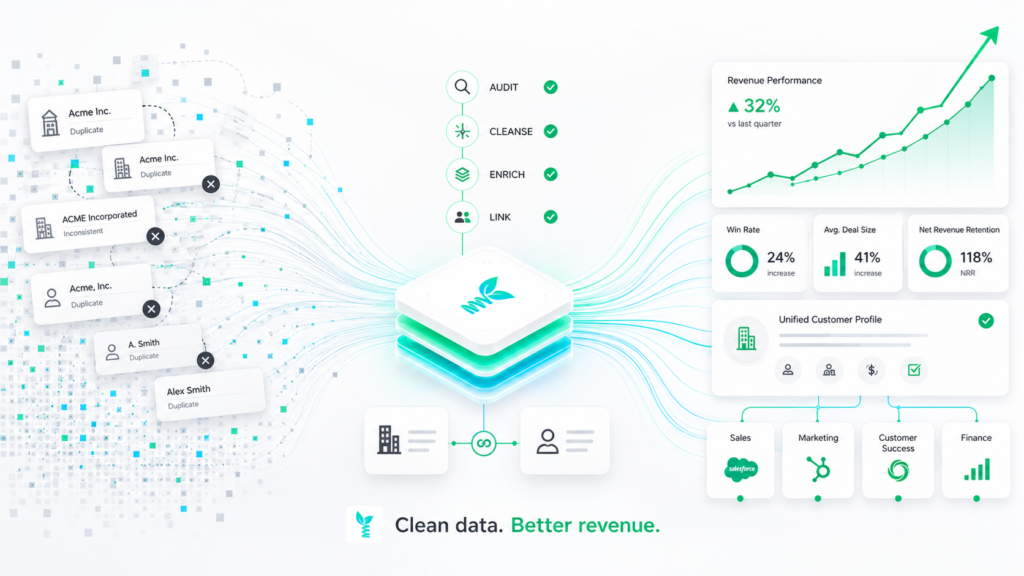
Once the audit is complete, SpringDB uses ZoomInfo to run a structured hygiene and governance process. The team typically starts with the report card capability in ZoomInfo Operations to surface duplication, field fill rates, and unverified records. From there it removes duplicates, verifies records, links leads to their parent accounts, and connects the cleaned data to ZoomInfo Sales and the client CRM for enrichment. For deeper improvements, SpringDB brings in the ZoomInfo Data as a Service team.
ZoomInfo is far more than a source of contact records in this work. On top of the cleaned foundation, SpringDB enriches accounts and personas with technographic data, buying intent signals, funding information, and firmographics, so that every account and every contact carries a fuller and more actionable profile. That unified, high-resolution layer is what makes precise segmentation, routing, and follow-up possible.
01 Audit Full system and data review to surface the real state of the database. | → | 02 Clean and Connect Dedupe, verify, link leads to accounts, and sync to CRM for enrichment. | → | 03 Build the Stack Embed ZoomInfo into daily workflows so teams work from one source. | → | 04 Infrastructure Load verticalized data into the warehouse for analytics and ICP work. |
Building a Connected Go-to-Market Stack
Clean data only creates value when every team works from it at once. That is what SpringDB means by a connected go-to-market motion. Rather than handing ZoomInfo to a single department, SpringDB wires the platform into the daily work of every revenue team, so that all of them draw on the same enriched layer.
| Sales | ZoomInfo Copilot. Representatives can spend close to a third of the day on research alone, so Copilot hands them a ready dashboard of priority accounts with the context they need to reach out. |
| Revenue operations | ZoomInfo Operations, including RingLead. Records stay deduplicated, normalized, and routed to the right owner without manual cleanup. |
| Marketing | ZoomInfo Marketing. Account-based marketing audiences and advertising run against the exact companies and personas in the ideal customer profile, so budget follows fit rather than guesswork. |
| Go-to-market engineering | GTM Studio and Agent Teams. Engineers build and automate plays, orchestrating research and activation at a speed that manual work cannot match. |
| Data science | ZoomInfo data cubes. Verticalized data loaded alongside first-party data helps model markets and sharpen the ideal customer profile. |
| Product | ZoomInfo API and MCP. Verified records pulled in bulk feed the team's own applications and foundation models. |
One enriched layer serving many teams is what makes the motion connected rather than fragmented.
Conversation intelligence holds the picture together. SpringDB integrates ZoomInfo Chorus, the conversation intelligence layer, for pipeline alerts and deal-risk tracking. The team sets alerts for warning signs in the deal cycle, such as single-threaded opportunities, missing decision makers, or competitor mentions, and syncs call transcripts into data warehouses. Used across the organization, that conversational data becomes a bridge between sales, marketing, and product.
Data Infrastructure as a Long-Term Advantage
Some of the most forward-looking work SpringDB does happens in data warehousing. Using ZoomInfo Data as a Service, the team loads fully verticalized data sets into client warehouse environments, where they can support stronger analytics, better data science, and richer ideal customer profile development. Combining ZoomInfo data cubes with a client's own first-party data moves segmentation from surface-level filtering to deep, scalable, strategic insight. For companies that want to build a genuinely data-driven culture, Kosturos treats this kind of infrastructure as essential rather than optional.
Wondering what an audit would surface in your own database? SpringDB starts every engagement there.
Explore Data ExchangeThe Outcomes
What the Results Look Like
The pattern of outcomes SpringDB documents across its engagements is consistent. As detailed in ZoomInfo's published SpringDB case study, clients typically report the following:
2 to 3x Campaign conversions rising across channels | 30 to 50% Average deal size growth |
20 to 40% Customer churn reduction | ~300% Increase in database usability |
Figures as reported in ZoomInfo's published SpringDB case study and a July 2026 ZoomInfo announcement.
SpringDB attributes the full set of results to a single root cause: data that is clean and connected, treated as a competitive advantage rather than an afterthought.
Looking Ahead
SpringDB is already putting ZoomInfo's newest capabilities to work. The GTM Studio and Agent Teams orchestration that powers its go-to-market engineers now extends into GTM Workspace, which turns those automated workflows into finished deliverables, including custom presentations built on the underlying data. Kosturos sees the combination of orchestration and workspace as a meaningful step change in how quickly a plan can move from idea to execution.
The Takeaway
SpringDB's engagements point to a simple truth that is easy to ignore: precision in the data layer is what turns go-to-market ambition into measurable revenue. The teams that treat data as infrastructure, and that use a platform like ZoomInfo across the whole revenue motion rather than inside a single silo, tend to unlock far more value than teams that treat it as a one-department tool. By Kosturos's estimate, the difference can be as large as ten times the value.
Turn a cluttered database into a dependable revenue engine
Through SpringDB Data Exchange, growth teams can audit, clean, enrich, and activate the data underneath their sales and marketing. To see what that could look like for your team, start with a Data Exchange conversation.
Explore SpringDB Data Exchange